The Situation
In early 2024, I worked for a national security organization with more than 3,000 employees across approximately 10 states and Puerto Rico, operating through at least five separate EINs. The distributed HR function included more than 14 HR staff.
The challenge wasn’t simply responding to employee questions. It was visibility. We had no centralized way to understand demand, identify recurring employee-relations trends, measure service levels, balance workload across the HR team, or identify emerging issues before they escalated.
With my experience in information technology, I realized there could be an easier way to manage these communications from a centralized hub, and gain insight into where the HR issue hotspots were located.
My background in information technology suggested a different operating model: centralize HR communications through a service-management platform capable of surfacing demand, trends, and organizational hotspots.
The answer was something familiar to virtually every IT organization: a ticketing system.
The Problem
Distributed HR teams were responding to issues at the field level with little visibility at the higher strategic level. The HR teams were unevenly staffed – with some EINs having more staff than others. The corporate HR team would hear of HR issues at the field level, only after they had become more problematic, requiring higher escalation. There was no centralized HR communication, and therefore no standardized response framework to ER issues.
What I Built
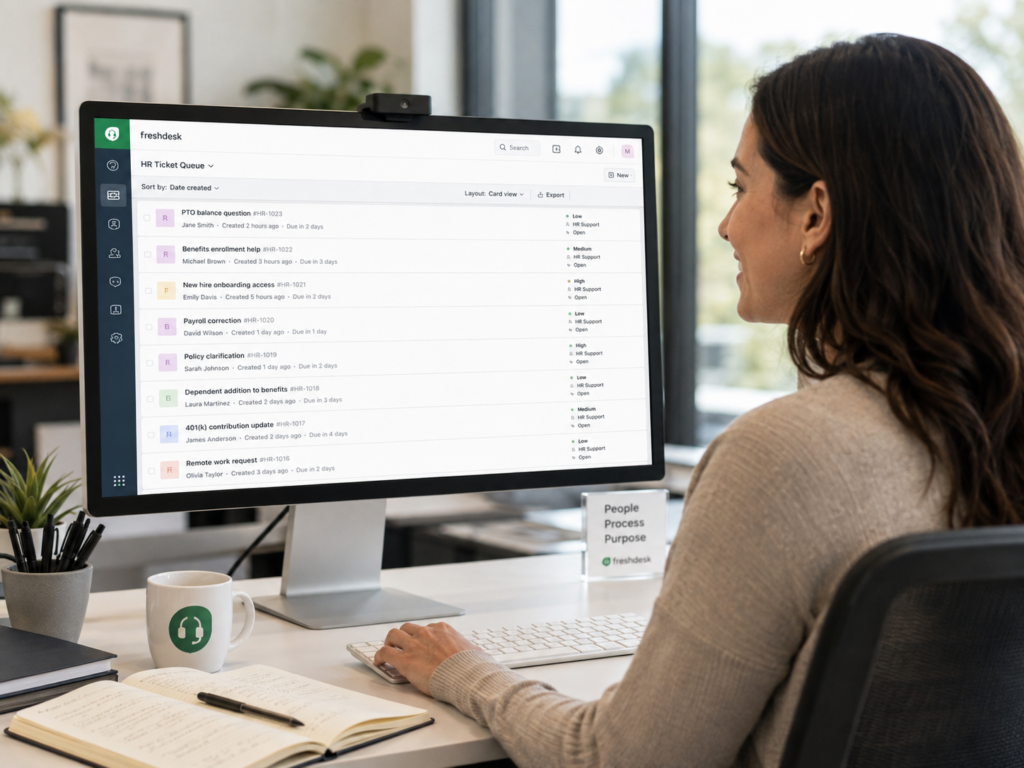
Using Freshworks’ Freshdesk cloud software, I independently designed and implemented an HR service-management platform for the distributed HR function. Utilizing proven change management strategies and project management skills I’ve built over my HR career, I acquired, designed, configured, built, and implemented this platform within four weeks – deploying a suite of resources, consistent communication workflows and automation where there was none before.
This looked like taking all of the existing HR emails which staff would send request to, and funneling them all through Freshdesk. Through distribution automation, I was able to maintain consistent communication to the right seats with nearly seamless integration. HR staff would nearly operate exclusively out of this new system, with the ability to develop numerous strategic HR controls, including:
- Enforcing HR Service Level Agreements for different HR disciplines, including benefits, ER issues, garnishments/payroll, onboarding, etc.
- Gaining reporting insight into the most common ER issues across EINs through ER classifications through embedded custom fields in ticketing management.
- Developing standard operating procedures in response to common HR issues by developing knowledgebase articles available within responses to ticketing.
- Developing standard templating responses to common HR emails, delivering consistent messaging to employees and staff.
- Creating training and development pathways for HR staff to cross train from knowledgebase articles.
- Developing escalation pathways for tickets failing programmed SLA response times, as well as keyword identification for dual routing escalation as needed, with better HR staff visibility on who is responding to which inquiry.
These integrations weren’t just email to ticket; there was extensive routing, permissions, and access segmentation purpose built to ensure that confidentiality remained key. HR staff were provided training on confidentiality, while sensitive matters including PHI/PII were routed outside the system through traditional systems and communication methods.
The Interesting Part
Freshdesk was built and marketed primarily as a customer-support platform, not as an HR case-management system. In a large PE-backed enterprise with multiple layers of complexity across several EINs, though there was skepticism that this would be the right product, it quickly became evident to HR staff and leadership that this was the missing link for distributed communication and management of so many HR needs.
Outcome
The result was more than a centralized inbox. It created an HR service-management infrastructure.
For the first time, HR demand could be categorized, assigned, measured, escalated, and analyzed across the enterprise. Issues that previously disappeared into distributed inboxes became structured data. Recurring questions became knowledge articles and standardized responses. SLA rules created accountability, while routing and escalation logic gave leadership visibility into emerging HR issues before they became larger organizational problems.
The same platform also became a continuously growing institutional knowledge base, allowing an understaffed HR team to share expertise, cross-train staff, and deliver more consistent service across a complex national organization.
This adaptation of IT Ticketing software became the primary intake and case-management channel across benefits, employee relations, onboarding and other HR functions.